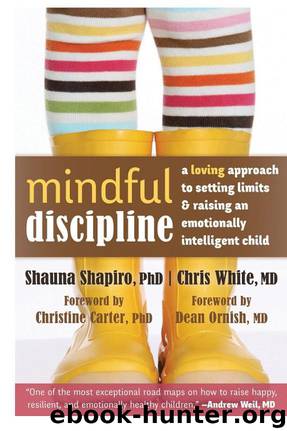
Mindful Discipline: A Loving Approach to Setting Limits and Raising an Emotionally Intelligent Child by Shauna Shapiro
Author:Shauna Shapiro
Language: eng
Format: mobi
Tags: parenting
ISBN: 9781608828869
Publisher: New Harbinger Publications
Published: 2014-06-19T04:00:00+00:00
Inherent Value
Part of developing a healthy sense of self occurs through a process psychologists call mirroring. We all have an innate need to be seen—and not as someone would like us to be, but rather as we are. Children look to our faces and our bodily responses to see “Am I welcome here? Can I be as I am? Can I feel and express what I feel?” Your child wants to know that she is understood, that her experience and her life matter to you. When our love is unconditional, the child simply retains a sense of the inherent value that she was born with. This is not a conscious thought like, “I am valuable,” but rather an implicit sense of the goodness and rightness of her existence. Look at any four-month-old baby; do you see any trace of shame in her eyes? No, she simply shines like the gift that she is, pulling on those newfound toes of hers. Inherent value is not something that is given; it is a human birthright to be preserved.
This is decidedly not self-esteem building. The self-esteem movement, while well intended, has been misguided by the idea that self-esteem is something that you can create from the outside through positive phrases and slogans: “You are so special”; “You are so smart”; “You can do and be anything you can imagine.” This pumping up of our children’s self-images has led to a whole host of problems like excessive self-focus, anxiety, inflated feelings of superiority or deflated feelings of inferiority, and an inability to assume adult responsibilities (Young-Eisendrath 2008). Too much focus on self-image communicates to a child that he is a thing that you are shaping, and that that thing is valuable only when it is positive, special, or accomplished. How confusing it must be when the child sometimes feels anger and hatred, or recognizes that he is not always the best, or when he discovers that there are actually natural limits in life to who and what he can be. Accepting ourselves in our totality—the good, the bad, and the ugly—is a key ingredient to a rich and fulfilling life.
It is important to help our children know that life is a process with ups and downs and all-arounds, and that none of these assessments changes the mystery and beauty that we are. A combination of unconditional love and straight-up feedback about what works and what does not keeps our children’s resilient nature and inherent sense of value intact. If we aim to preserve their sense of inherent value, we
Download
This site does not store any files on its server. We only index and link to content provided by other sites. Please contact the content providers to delete copyright contents if any and email us, we'll remove relevant links or contents immediately.
The Lost Art of Listening by Michael P. Nichols(7506)
Rich Dad Poor Dad by Robert T. Kiyosaki(6632)
We Need to Talk by Celeste Headlee(5615)
I Love You But I Don't Trust You by Mira Kirshenbaum(3876)
The Complete Idiot's Guide to Coping With Difficult People by Arlene Uhl(3149)
Rich Dad Poor Dad: What The Rich Teach Their Kids About Money - That The Poor And Middle Class Do Not! by Robert T. Kiyosaki(2958)
A Burst of Light by Audre Lorde(2607)
The Book You Wish Your Parents Had Read (and Your Children Will Be Glad That You Did) by Philippa Perry(2528)
Dealing with People You Can't Stand by Dr. Rick Brinkman(2460)
Life Hacks by Dan Marshall(2456)
An Odyssey by Daniel Mendelsohn(2307)
The Expectant Father by Armin A. Brott & Jennifer Ash(2273)
Teach Your Child How to Think by Edward De Bono(2159)
No Time to Say Goodbye(2116)
What I Need by J. Daniels(2081)
The 7 Habits Of Highly Effective Teens by Covey Sean(2080)
The Out-of-Sync Child by Carol Stock Kranowitz(2054)
The Anxious Generation by Jonathan Haidt(2049)
I Don't Belong to You by Keke Palmer(2005)
